I got this recipe from my friend Allen. He says he can't imagine Epiphany without this soup. As far as I'm concerned, it's a good hearty soup that's comforting when the weather outside is frightful.
Give this one a go. If you want to make this vegetarian, omit the bacon and sauté the onions and the celery in olive oil. Note that because there is cheese here, this would be considered lacto but not vegan.
1/2 lb bacon, diced
1/3 c celery, chopped
1/3 c onion, chopped
4 c potatoes, peeled and diced
3 c chicken broth (or vegetable broth for vegetarian)
2 c milk (better if allowed to warm up to room temperature)
1/2 tsp salt
1/4 tsp pepper
dash paprika
2 c cheddar cheese, grated
In a large pot, brown the bacon until crisp and the oil is rendered. Add the celery and onion and sauté until softened. Remove from pan and set aside.
In the same pot, add the potatoes and chicken broth and cook until potatoes are tender and falling apart. This will make it easier to mash the potatoes in the broth. Use either a potato masher or a hand blender for this purpose.
Add the bacon, celery, and onion mixture, as well as the spices to the potato mixture. Add the milk whilst stirring. Heat until hot.
Shortly before serving, add the cheese and stir until melted.
Serves 8.
Note: I did not add any salt because there was plenty of salt from the bacon and the cheese. In addition, I increased the pepper (using freshly ground pepper) and put in a couple of dashes of paprika.
If I had a digital camera, I'd take a picture of this lovely soup. Enjoy!
Tuesday, February 3, 2009


2 February - The Feast of the Presentation of Our Lord Jesus Christ
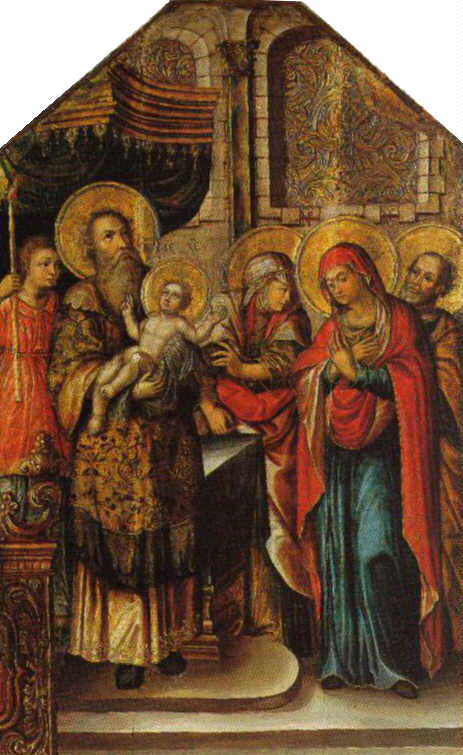
Last night, I sang with the Parish Choir at Chapel of the Cross. I've sung this particular service several times over the past few years ... and it's as beautiful as I've always remembered it. I'm just going to list the music we've done here, but we've generally started the service in the courtyard, with everyone holding candles in their hands. We process into a darkened church, led by crucifer, acolytes, and thurifer. (It was a Solemn Eucharist Rite II, so the incense was present.) Most of the beginning of the service was chanted a cappella. After the Gloria was chanted and the Collect of the Day prayed, the candles were extinguished and the lights turned on. There was plenty of chanting - the Gospel was chanted by the deacon, as were the appropriate responses before and after. The Nicene Creed was also chanted in a monotone. The Prayers of the People were also chanted, as were the responses for The Peace, the Sursum Corda, and the Eucharistic Prayer before the Sanctus. The Dismissal was also chanted as well. It was nice to hear all of that. After the Post-Communion Prayer, as the choir was singing the Arcadelt setting of Ave Maria, the lights were extinguished and the candles re-lit. As the Recessional Hymn was sung, everyone recessed out in the same way we processed in - darkened church, everyone holding the lit candles in their hands.
Here is the music, minus the chanted parts of the service that I had already indicated above.
Candlemas: The Feast of the Presentation of Our Lord Jesus Christ in the Temple: Procession and Solemn Eucharist Rite II
Nunc dimittis (Mode VIII)
Hymn in Procession: Creator of the stars of night (CONDITOR ALME SIDERUM)
Magnus Dominus (Psalm 48:1-2, 10-13; Mode I)
Gloria in excelsis (Mode VIII)
Psalm: Ps 84:1-6 (Simplified Anglican Chant; setting unknown)
Sequence Hymn: O Zion, open wide thy gates (EDMONTON)
Offertory: How beautiful are the feet of him (G. F. Handel)
Sanctus: Deutsche Messe (F. Schubert; adapt. R. Proulx)
Lord's Prayer: As found in S-119 in The Hymnal 1982, chanted a cappella
Communion Hymn: Virgin born, we bow before thee (PSALM 86)
Motet during the Lighting of the Candles: Ave Maria (J. Arcadelt)
Hymn in Procession: Angels from the realms of glory (REGENT SQUARE)
Postlude: Fuga sopra il Magnificat (J. S. Bach)
And the people are instructed to carry the Light of Christ out into the world.
The Organist-Choirmaster was Dr Wylie S Quinn III, and the Parish Choir, assisted by four current and past members of the Senior Choir, served as the service choir.
(Note: the picture above was "borrowed" from the Belarusian School of Icon Painting. Author unknown; Wooden board, egg tempura, 149.5 x 94 x 3 cm)
Monday, February 2, 2009
1 February - Fourth Sunday after Epiphany
Here are my usual lists.
St. Joseph's Episcopal Church where I played the usual 10.30 am service. As usual, the numbers are out of The Hymnal 1982.
Fourth Sunday After Epiphany: Holy Eucharist Rite II
Prelude: Prelude in d minor (attr. J.S. Bach)
Pro: 569, God the Omnipotent! King, who ordainest (RUSSIA)
Gloria: S-278 (W. Mathias)
Psalm: Psalm 111 (Barrett)
Seq: 567, Thine arm, O Lord, in days of old (ST. MATTHEW)
Off: Gather Comprehensive 726, Make me a channel of your peace (PRAYER OF ST. FRANCIS)
Sanctus: S-128 (W. Mathias)
Lord's Prayer: chanted (S-119 in Hymnal 1982)
Agnus Dei: S-165 (W. Mathias)
Communion Motet: Jesus Christ the Apple Tree (arr. A. Bullard)
Re: 535, Ye servants of God, your Master proclaim (PADERBORN)
Postlude: Fugue in d minor (attr. Bach)
The Episcopal Centre at Duke University.
Fourth Sunday After Epiphany: Holy Eucharist Rite II
Pro: 569, God the Omnipotent! King, who ordainest (RUSSIA)
Gloria: S-280 (R. Powell)
Psalm: Psalm 111 (recited)
Seq: 567, Thine arm, O Lord, in days of old (ST. MATTHEW)
Off: 339, Deck thyself, my soul, with gladness (SCHMÜCKE DICH)
Sanctus: S-125 (Community Mass; Proulx)
Comm: WLP 831, Ubi Caritas (Taizé)
Re: 535, Ye servants of God, your Master proclaim (PADERBORN)
Postlude: Alternate harmonisation of Paderborn (N. Rawsthorne)
Compline at the Chapel of the Cross. We've been using the Order for Compline, as set by David Hurd.
Here are our little additions:
O nata lux (Thomas Tallis)
Psalm 91 (chanted to Tone 8)
Hymn: Christ, mighty Saviour (CHRISTE, LUX MUNDI, plainsong Mode 7)
In manus tuas (Sheppard; sung in addition to "Into your hands, O Lord, I commend my spirit ...)
Nunc Dimittis from Short Service (O. Gibbons)
Alma Redemptoris Mater (Marian antiphon right after the Dismissal)
Ave Maria (Robert Parsons)
Organ Voluntary by the abfab David Arcus.
This will be the last week we chant Alma Redemptoris Mater because next week, we switch over to Ave Regina Cælorum. From the International Marian Research Institute in Dayton, Ohio:
St. Joseph's Episcopal Church where I played the usual 10.30 am service. As usual, the numbers are out of The Hymnal 1982.
Fourth Sunday After Epiphany: Holy Eucharist Rite II
Prelude: Prelude in d minor (attr. J.S. Bach)
Pro: 569, God the Omnipotent! King, who ordainest (RUSSIA)
Gloria: S-278 (W. Mathias)
Psalm: Psalm 111 (Barrett)
Seq: 567, Thine arm, O Lord, in days of old (ST. MATTHEW)
Off: Gather Comprehensive 726, Make me a channel of your peace (PRAYER OF ST. FRANCIS)
Sanctus: S-128 (W. Mathias)
Lord's Prayer: chanted (S-119 in Hymnal 1982)
Agnus Dei: S-165 (W. Mathias)
Communion Motet: Jesus Christ the Apple Tree (arr. A. Bullard)
Re: 535, Ye servants of God, your Master proclaim (PADERBORN)
Postlude: Fugue in d minor (attr. Bach)
The Episcopal Centre at Duke University.
Fourth Sunday After Epiphany: Holy Eucharist Rite II
Pro: 569, God the Omnipotent! King, who ordainest (RUSSIA)
Gloria: S-280 (R. Powell)
Psalm: Psalm 111 (recited)
Seq: 567, Thine arm, O Lord, in days of old (ST. MATTHEW)
Off: 339, Deck thyself, my soul, with gladness (SCHMÜCKE DICH)
Sanctus: S-125 (Community Mass; Proulx)
Comm: WLP 831, Ubi Caritas (Taizé)
Re: 535, Ye servants of God, your Master proclaim (PADERBORN)
Postlude: Alternate harmonisation of Paderborn (N. Rawsthorne)
Compline at the Chapel of the Cross. We've been using the Order for Compline, as set by David Hurd.
Here are our little additions:
O nata lux (Thomas Tallis)
Psalm 91 (chanted to Tone 8)
Hymn: Christ, mighty Saviour (CHRISTE, LUX MUNDI, plainsong Mode 7)
In manus tuas (Sheppard; sung in addition to "Into your hands, O Lord, I commend my spirit ...)
Nunc Dimittis from Short Service (O. Gibbons)
Alma Redemptoris Mater (Marian antiphon right after the Dismissal)
Ave Maria (Robert Parsons)
Organ Voluntary by the abfab David Arcus.
This will be the last week we chant Alma Redemptoris Mater because next week, we switch over to Ave Regina Cælorum. From the International Marian Research Institute in Dayton, Ohio:
Although many musical settings of the Ave Regina Cælorum abound, it is the least known antiphon as a prayer or as a popular hymn. As mentioned above the antiphon is sung in plainchant during the Lenten season. Mary, in all her dignity and loveliness, should walk this way with us. Even in the midst of her deepest sorrow, while she shares the destiny of her son, her dignity and her beauty is not crushed. She accompanies Christ--and us--through the painful periods of life. The antiphon reminds us to pray with Mary to the God of life, our living redeemer, Jesus Christ. He has won the final victory of life over death. She and we may share this victory.
Sunday, February 1, 2009
25 January - Third Sunday after Epiphany
Somehow, I knew I had forgotten something. Here are last week's music lists.
St. Joseph's Episcopal Church where I played the usual 10.30 am service. As usual, the numbers are out of The Hymnal 1982.
Third Sunday After Epiphany: Holy Eucharist Rite II
Prelude: Praeludium in G Major (Op. 37, No. 2; F. Mendelssohn)
Pro: 408, Sing praise to God who reigns above (MIT FREUDEN ZART)
Gloria: S-278 (W. Mathias)
Psalm: Psalm 62 (Barrett)
Seq: 550, Jesus calls us; o'er the tumult (RESTORATION)
Off: 660, O Master, let me walk with thee (MARYTON)
Sanctus: S-128 (W. Mathias)
Lord's Prayer: chanted (S-119 in Hymnal 1982)
Agnus Dei: S-165 (W. Mathias)
Comm:
Postlude: Finale from Organ Sonata VI (Op. 65, No. 6; Mendelssohn)
Moving right along ... this next set, the music was nearly identical, with the exception of the Communion hymn.
The Episcopal Centre at Duke University.
Third Sunday After Epiphany: Holy Eucharist Rite II
Prelude: Improvisation on Georgetown
Pro: 408, Sing praise to God who reigns above (MIT FREUDEN ZART)
Gloria: S-280 (R. Powell)
Psalm: Psalm 62(recited)
Seq: 550, Jesus calls us; o'er the tumult (RESTORATION)
Off: 660, O Master, let me walk with thee (MARYTON)
Sanctus: S-125 (Community Mass; Proulx)
Comm: 661, They cast their nets in Galilee (GEORGETOWN)
Re: 537, Christ for the world we sing! (MOSCOW)
Postlude: Finale from Organ Sonata VI (Op. 65, No. 6; Mendelssohn)
Yes, I did *that* postlude. I just omitted the pedal part. It seemed a bit strange, but then again, who would know that something was missing?
Compline at the Chapel of the Cross. We've been using the Order for Compline, as set by David Hurd.
Here are our little additions:
O nata lux (Thomas Tallis)
Psalm 4 and 134 (chanted to Tone 8)
Hymn: O Christ, you are both light and day (CHRISTE, QUI LUX ES ET DIES, plainsong Mode 2)
Nunc Dimittis from Short Service (O. Gibbons)
Alma Redemptoris Mater (Marian antiphon right after the Dismissal)
Ave Maria (Robert Parsons)
Organ Voluntary by the abfab David Arcus.
St. Joseph's Episcopal Church where I played the usual 10.30 am service. As usual, the numbers are out of The Hymnal 1982.
Third Sunday After Epiphany: Holy Eucharist Rite II
Prelude: Praeludium in G Major (Op. 37, No. 2; F. Mendelssohn)
Pro: 408, Sing praise to God who reigns above (MIT FREUDEN ZART)
Gloria: S-278 (W. Mathias)
Psalm: Psalm 62 (Barrett)
Seq: 550, Jesus calls us; o'er the tumult (RESTORATION)
Off: 660, O Master, let me walk with thee (MARYTON)
Sanctus: S-128 (W. Mathias)
Lord's Prayer: chanted (S-119 in Hymnal 1982)
Agnus Dei: S-165 (W. Mathias)
Comm:
- Motet: Lord, for thy tender mercy's sake (R. Farrant)
- Hymn: Gather Comprehensive 696, Lord, when you came to the seashore (PESCADOR DE HOMBRES)
Postlude: Finale from Organ Sonata VI (Op. 65, No. 6; Mendelssohn)
Moving right along ... this next set, the music was nearly identical, with the exception of the Communion hymn.
The Episcopal Centre at Duke University.
Third Sunday After Epiphany: Holy Eucharist Rite II
Prelude: Improvisation on Georgetown
Pro: 408, Sing praise to God who reigns above (MIT FREUDEN ZART)
Gloria: S-280 (R. Powell)
Psalm: Psalm 62(recited)
Seq: 550, Jesus calls us; o'er the tumult (RESTORATION)
Off: 660, O Master, let me walk with thee (MARYTON)
Sanctus: S-125 (Community Mass; Proulx)
Comm: 661, They cast their nets in Galilee (GEORGETOWN)
Re: 537, Christ for the world we sing! (MOSCOW)
Postlude: Finale from Organ Sonata VI (Op. 65, No. 6; Mendelssohn)
Yes, I did *that* postlude. I just omitted the pedal part. It seemed a bit strange, but then again, who would know that something was missing?
Compline at the Chapel of the Cross. We've been using the Order for Compline, as set by David Hurd.
Here are our little additions:
O nata lux (Thomas Tallis)
Psalm 4 and 134 (chanted to Tone 8)
Hymn: O Christ, you are both light and day (CHRISTE, QUI LUX ES ET DIES, plainsong Mode 2)
Nunc Dimittis from Short Service (O. Gibbons)
Alma Redemptoris Mater (Marian antiphon right after the Dismissal)
Ave Maria (Robert Parsons)
Organ Voluntary by the abfab David Arcus.
Saturday, January 24, 2009
Filipinos and Funeral Traditions
Having sung at a funeral this morning, and spending time with friends from the Filipino community after the Rite of Committal at the cemetery, it made me think of Filipino funeral traditions, some of which we were discussing at the reception.
First of all, for Filipinos, it's a celebration of life. Filipinos are very reverent of the dead, paying homage and tribute to loved ones who have gone before them. In the days following a person's death, the surviving relatives are surrounded by many friends and family to give them love and support. Most Filipinos are Roman Catholics, and so there are many Catholic traditions intertwined. When my cousin and uncle had passed away, we prayed the rosary together for nine days, a Novena of sorts. The 40th day was also important as well - the soul of the deceased will have ascended to heaven.
People are always around, visiting relatives in the house, or spending time at the funeral home, where there is an open-casket viewing. When my maternal grandfather passed away, the casket was in the house, where visitors filed in to pay respects to him and to give love and support to my family. Then there was a procession from the house to the church.
Another thing I noticed as a difference between traditions amongst Filipinos and Americans - people asked how did Miko die, and the information was freely volunteered. (It was a sad story, btw.) This is the Filipino way of expressing care and concern and condolences for those who were left behind.
I started thinking about the Filipino customs as we were at the cemetery. There must be some sort of a NC state law that prohibits people from being present as the casket is lowered to the ground. From Filipino graveside services I've gone to in the past outside of NC, I remember that the casket would be lowered, and everyone would toss a flower in the grave. I can't remember if people also add a scoop of dirt to the grave as well. I do recall a young child being passed over the grave ... was it three times? or was it seven? ... The reasoning behind this: babies and children are made to cross over the coffin of the dead and back again lest the dead departed will come to "haunt" them. At this graveside service, the boutinneres the pallbearers were wearing were placed on the casket, followed by long-stemmed white roses the immediate family members were holding. Then they approached the casket, kissed it, and bade Miko goodbye. We were then asked to leave even though the casket had not been lowered into the ground yet.
Then afterward, everyone went on to a reception at a local hotel. Their original plans were to have it back at the church, but a wedding dashed those plans. Naturally for Filipinos, there was a lot of food. Despite the fact there were far more people present than they expected, there was still a lot of food left over at the end.
Before I go on, I must also mention that Filipinos can be quite superstitious as well. As the reception was ending, we were asked if we'd like to take some food home with us. From what I recall, whatever food was served at wakes, receptions, etc. doesn't go home with you because of the belief that the dead touches all of it. I noticed that not many people took food with them. Several people made the suggestion that the left over food should be taken to Urban Ministries of Durham, where they run a soup kitchen and a shelter for the homeless.
There are a few other superstitions connected with funerals and burials and the like. This list came from Filipinas magazine, and several Filipino bloggers have commented on it or reproduced the list on their blogs. I'm borrowing it from Mel Santos' blog, In Fraternam Meam.
First of all, for Filipinos, it's a celebration of life. Filipinos are very reverent of the dead, paying homage and tribute to loved ones who have gone before them. In the days following a person's death, the surviving relatives are surrounded by many friends and family to give them love and support. Most Filipinos are Roman Catholics, and so there are many Catholic traditions intertwined. When my cousin and uncle had passed away, we prayed the rosary together for nine days, a Novena of sorts. The 40th day was also important as well - the soul of the deceased will have ascended to heaven.
People are always around, visiting relatives in the house, or spending time at the funeral home, where there is an open-casket viewing. When my maternal grandfather passed away, the casket was in the house, where visitors filed in to pay respects to him and to give love and support to my family. Then there was a procession from the house to the church.
Another thing I noticed as a difference between traditions amongst Filipinos and Americans - people asked how did Miko die, and the information was freely volunteered. (It was a sad story, btw.) This is the Filipino way of expressing care and concern and condolences for those who were left behind.
I started thinking about the Filipino customs as we were at the cemetery. There must be some sort of a NC state law that prohibits people from being present as the casket is lowered to the ground. From Filipino graveside services I've gone to in the past outside of NC, I remember that the casket would be lowered, and everyone would toss a flower in the grave. I can't remember if people also add a scoop of dirt to the grave as well. I do recall a young child being passed over the grave ... was it three times? or was it seven? ... The reasoning behind this: babies and children are made to cross over the coffin of the dead and back again lest the dead departed will come to "haunt" them. At this graveside service, the boutinneres the pallbearers were wearing were placed on the casket, followed by long-stemmed white roses the immediate family members were holding. Then they approached the casket, kissed it, and bade Miko goodbye. We were then asked to leave even though the casket had not been lowered into the ground yet.
Then afterward, everyone went on to a reception at a local hotel. Their original plans were to have it back at the church, but a wedding dashed those plans. Naturally for Filipinos, there was a lot of food. Despite the fact there were far more people present than they expected, there was still a lot of food left over at the end.
Before I go on, I must also mention that Filipinos can be quite superstitious as well. As the reception was ending, we were asked if we'd like to take some food home with us. From what I recall, whatever food was served at wakes, receptions, etc. doesn't go home with you because of the belief that the dead touches all of it. I noticed that not many people took food with them. Several people made the suggestion that the left over food should be taken to Urban Ministries of Durham, where they run a soup kitchen and a shelter for the homeless.
There are a few other superstitions connected with funerals and burials and the like. This list came from Filipinas magazine, and several Filipino bloggers have commented on it or reproduced the list on their blogs. I'm borrowing it from Mel Santos' blog, In Fraternam Meam.
- Feed the mourners, but don't walk them to the door when they leave.
- Don't sweep the floor while the body is still lying in state.
- No tears should fall on the dead or the coffin as it woild make a person's journey to the afterlife difficult.
- When someone sneezes at the wake, pinch him.
- During the wake the dead person's relatives musn't take a bath.
- Food from the wake shouldn't be brought home because it's believed that the dead touches all of it.
- After a funeral service, guests shouldn't go directly home. This way the spirit of the dead won't follow them to their house.
- When carrying a coffin out for burial, it should be carried head first as it prevents the soul of the dead from coming back.
- Before a man comes home from a funeral he should light a cigarette from a fire at the cemetery gate to shake off spirits of the dead.
- The corpse should be positioned facing the door - the feet should be facing toward the door so it will allow the spirit to depart easily.
- Family members should wear black or white, colors are prohibited.
- Weddings, birthdays, and other social activities shouldn't be celebrated for one year.
Mass of the Resurrection for Jon Michael Bernardo (1982-2009)
 This morning, I sang at the Funeral Mass for Miko Bernardo. This was particularly sad. I didn't know Miko, but I had an acquaintance with his uncles and aunts, the Gadrinabs and the Estradas. Miko was only 26 years old. He was a third-year medical student at Virginia College of Osteopathic Medicine, and was in the Dominican Republic for a clinical rotation when he was involved in a car accident. I felt badly for his mum and his family because Miko's father, who was also a doctor, had died from I believe a brain tumour a few years ago, and now his son, who wanted to follow in his footsteps, had his chance taken from him too soon.
I will list the music from Miko's funeral Mass here, and then I'll write my thoughts on Filipino funeral traditions in another blog post. Any numbers you see come out of GIA's Gather Comprehensive 1994 (green cover).
Prelude: Hindi kita malilimutan ("I will never forget you"; M. V. Francisco)
Opening Hymn: 524, Holy God we praise Thy name (GROSSER GOTT)
Psalm: 31, Psalm 23 Paraphrase, Shepherd Me, O God (M. Haugen)
Gospel Acclamation: 258, Celtic Alleluia (F. O'Carroll/C. Walker)
Offertory: 649, You are mine (D. Haas)
Sanctus, Mem. Accl., Amen, Agnus Dei: 166-171, Mass of Creation (M. Haugen)
Communion Hymn: 828, I am the bread of life (S. Toolan)
Communion Meditations:
- Sino Ako? ("Who am I?"; J. Castañeda)
- I can only imagine (B. Millard)
Closing Hymn: 528, Joyful, joyful, we adore you (HYMN TO JOY)
Members from the NC Filipino Choir joined with IC's Resurrection Choir to sing for this Mass.
Mendelssohn Progressive Recital
 The Durham-Chapel Hill chapter of the American Guild of Organists presented a Progressive Recital featuring the music of Felix Mendelssohn last night. Chapter members played Mendelssohn's organ music, and the program was divided between two downtown Chapel Hill churches.
We started at University Presbyterian Church on Franklin Street. They have a beautiful 3-manual, 50-rank Sipe organ. Here is the music that was performed there:
- Organ Sonata No 4 in B-Flat Major, Op 65 (David Durkop)
- Allegro con brio
- Andante religioso
- Allegretto
- Allegro maestoso
- Praeludium in G-Major, Op 37 (Lyn Francisco)
- Organ Sonata No 5 in D-Major, Op 65 (Mark Gorman)
- Andante
- Andante con moto
- Allegro
We then moved across the street to University United Methodist Church for the second half of the program. A three-manual, 50-rank Möller lives there but is unique because of the split nature: 2/3 of the organ is up in the Gallery while 1/3 of the organ is up in the chancel, giving it a "surround sound" type of effect if stops from both organs are pulled at the same time. It is the organ on which I learnt how to play as my organ teacher, Tim Baker, is the Director of Music there.
Here is the rest of the program:
- Organ Sonata No 6 in d-minor, Op 65 (Tim Baker)
- Chorale and Variations: Andante sostenuto
- Allegro molto
- Fuga
- Finale: Andante
- Hear ye, Israel; hear what the Lord speaketh from Elijah (Summer Kinard, soprano; Lyn Francisco, organ)
- Organ Sonata No 2 in c-minor, Op 65 (Daniel Steinert)
- Grave-Adagio
- Allegro maestoso e vivace
- Fuga: Allegro moderato
It was fun to participate in this recital, but oh my, the nerves! I was very underconfident in accompanying my friend for the Elijah piece, but we somehow survived it. I'll keep working on it because we're going to record that piece, amongst others.
I was chuffed at the attendance. We had no idea what to expect as far as numbers were concerned, so I printed 70 programs. We ran out. I guess having it written up in the local media helps. Plus, people said they came because they loved the music of Mendelssohn. Speaking of which - 3rd February will be the 200th anniversary of Mendelssohn's birth, so I am sure we'll be hearing a lot of his music by organists in the coming year. I am working on Sonata No 2, so this should be a motivation for me to keep working on it. It's not easy, and the second movement (Adagio) has me tied up in knots. The hands cross over on the manuals, and I had found it physically challenging to play.
I had learnt the Praeludium specifically for this recital; now I am happy to be able to add it to my repertoire, and I'll be playing it as prelude music for this Sunday's service at St Joseph's. I might dig up some of Mendelssohn's piano music for prelude/postlude music for the Episcopal Centre at Duke ...
Tuesday, January 20, 2009
Almondigas at Misua
 Late last week, I made almondigas and misua soup. Almondigas are meatballs, and misua is a fine
 This is a very easy recipe. When I was in grad school, I had experimented with ovo-versions of this soup. Click here and here for a couple of meatless examples.
As for what I made last week, here is that recipe.
Almondigas:
- 1 lb ground beef
- 1/2 c onion, chopped finely (I ♥ my Cuisinart mini-prep processor!)
- 1/4 c celery, chopped finely
- 2-3 tbsp flour
- 1 egg
- salt and pepper to taste
Mix all ingredients and form into balls. Fry or bake until done, then drain and set aside. (Note: my mum has been able to just drop them into boiling water, but the two times I tried doing this, my meatballs fell apart. I wish I knew what I was doing wrong here. If you've any suggestions, feel free to leave a comment.)
Misua soup:
- 1 small onion, chopped
- garlic, chopped (I love garlic, and I tend to use a lot. I'd say no less than two cloves)
- Your choice of: zucchini/courgette (3 small), patola (1), sayote (1), or some other similar squash-like item, sliced
- Patis (or salt) and pepper to taste
- 6 cups water or broth of choice
- 3 bundles (ca. 100 g each, I think) misua noodles
- Almondigas
- Egg (optional)
Sauté garlic and onion in oil until softened. Add the squash and cook for a couple of minutes. Add the water or broth and the patis/salt and pepper and bring to a gentle boil. Add the almondigas and the misua, carefully stirring to ensure the noodles don't stick to each other. Because the noodles are very fine and delicate, they won't need any more than 2-3 minutes to cook. Drop the eggs whole into the gently boiling soup, cover and remove from heat, allowing the eggs to cook. Alternatively, you can medium-boil the eggs separately, and then cut them in half and serve a half with each bowl of soup.
That's it. It's one of my favourite comfort foods when the weather is cold outside.
Monday, January 19, 2009
18 January - Second Sunday after Epiphany
Compline is back. :) The music we sang at that service will follow.
In the meantime, here are my usual lists.
St. Joseph's Episcopal Church where I played the usual 10.30 am service. As usual, the numbers are out of The Hymnal 1982.
Second Sunday After Epiphany: Holy Eucharist Rite II
Prelude: Prelude in C Major (attributed to J.S. Bach)
Pro: 371, Thou, whose almighty word (MOSCOW)
Gloria: S-278 (W. Mathias)
Psalm: Psalm 139 (Ford; plainsong Mode 3)
Seq: 656, Blest are the pure in heart (FRANCONIA)
Off: 477, All praise to thee, for thou, O King divine (ENGELBERG)
Sanctus: S-128 (W. Mathias)
Lord's Prayer: chanted (S-119 in Hymnal 1982)
Agnus Dei: S-165 (W. Mathias)
Comm: Gather Comprehensive 671, Here I Am, Lord (D. Schutte)
Re: 535, Ye servants of God, your Master proclaim (PADERBORN)
Postlude: Fugue in C Major (attributed to Bach)
Okay, before you throw rotten tomatoes at me because of my Communion choice: this group has in the pews an in-house songbook, which consists mainly of folk and praise worship type of songs. This is one that apparently this group knows and loves well. However, unlike with other hymns, I didn't hear much singing from the congregation during Communion. *shrugs* I know, from my experience, that not many congregations will actually sing during Communion. So I'm not sure if it's the placement of this song, or if it's the song itself. I will admit that it's not amongst my favourites, but I thought it complimented the first reading of the day (1 Samuel 3:1-10).
Moving right along ... this next set, the music was nearly identical, with the exception of the Communion hymn.
The Episcopal Centre at Duke University.
Second Sunday After Epiphany: Holy Eucharist Rite II
Prelude: Improvisation on Halton Holgate
Pro: 371, Thou, whose almighty word (MOSCOW)
Gloria: S-280 (R. Powell)
Psalm: Psalm 139 (recited)
Seq: 656, Blest are the pure in heart (FRANCONIA)
Off: 477, All praise to thee, for thou, O King divine (ENGELBERG)
Sanctus: S-125 (Community Mass; Proulx)
Comm: 706, In your mercy, Lord, you called me (HALTON HOLGATE)
Re: 535, Ye servants of God, your Master proclaim (PADERBORN)
Postlude: Fugue in C Major (attributed to Bach)
Much to my surprise, the students didn't seem to sing the Offertory hymn all that well. Or rather, I played through most of the first verse before they joined in. I wondered, didn't I make it obvious when my introduction ended? Naturally, I couldn't stop and say, "Okay guys, let's try this again," so I just kept on going. I thought they wouldn't know the Communion hymn so well, but they sang that quite well, I thought. I played my postlude without the pedal, which made the fugue a little thin. But I couldn't do anything else with the little Holtkamp positif organ short of picking out a different piece, or flex my paltry improvisational muscles.
Squee! Compline at the Chapel of the Cross is back! :-) Attendance was quite good, and it was really really nice to be back and chanting once again. For my readers in the Triangle area – you really ought to come to this service at least once. Imagine this: you walk into a darkened church, illuminated only by candlelight. The smells of incense envelope you like a warm, smoky blanket. And then, the sounds of the Schola chanting the Order for Compline (starting at p 127 in the BCP) swirl around you as it takes you up to a different plane. And then after the last strains of the Ave Maria of the day die down, the abfab David Arcus concludes the service with his improvisation of the night. Then, the acolyte snuffs the six candles behind the altar, and this is a sign for the people to depart.
/sighs contentedly
Ah yes. The music. We've been using the Order for Compline, as set by David Hurd.
Here are our little additions:
Domine fac mecum (Thomas Morley)
Psalm 91 (chanted to Tone 8)
Hymn: Christ, mighty Saviour (CHRISTE, LUX MUNDI, plainsong Mode 7)
In manus tuas (Sheppard; sung in addition to "Into your hands, O Lord, I commend my spirit ...)
Nunc Dimittis from Short Service (O. Gibbons)
Alma Redemptoris Mater (Marian antiphon right after the Dismissal)
Ave Maria (Tomas Luis de Victoria)
Organ Voluntary by the abfab David Arcus. He improvised on a theme from Christe, Lux Mundi.
In the meantime, here are my usual lists.
St. Joseph's Episcopal Church where I played the usual 10.30 am service. As usual, the numbers are out of The Hymnal 1982.
Second Sunday After Epiphany: Holy Eucharist Rite II
Prelude: Prelude in C Major (attributed to J.S. Bach)
Pro: 371, Thou, whose almighty word (MOSCOW)
Gloria: S-278 (W. Mathias)
Psalm: Psalm 139 (Ford; plainsong Mode 3)
Seq: 656, Blest are the pure in heart (FRANCONIA)
Off: 477, All praise to thee, for thou, O King divine (ENGELBERG)
Sanctus: S-128 (W. Mathias)
Lord's Prayer: chanted (S-119 in Hymnal 1982)
Agnus Dei: S-165 (W. Mathias)
Comm: Gather Comprehensive 671, Here I Am, Lord (D. Schutte)
Re: 535, Ye servants of God, your Master proclaim (PADERBORN)
Postlude: Fugue in C Major (attributed to Bach)
Okay, before you throw rotten tomatoes at me because of my Communion choice: this group has in the pews an in-house songbook, which consists mainly of folk and praise worship type of songs. This is one that apparently this group knows and loves well. However, unlike with other hymns, I didn't hear much singing from the congregation during Communion. *shrugs* I know, from my experience, that not many congregations will actually sing during Communion. So I'm not sure if it's the placement of this song, or if it's the song itself. I will admit that it's not amongst my favourites, but I thought it complimented the first reading of the day (1 Samuel 3:1-10).
Moving right along ... this next set, the music was nearly identical, with the exception of the Communion hymn.
The Episcopal Centre at Duke University.
Second Sunday After Epiphany: Holy Eucharist Rite II
Prelude: Improvisation on Halton Holgate
Pro: 371, Thou, whose almighty word (MOSCOW)
Gloria: S-280 (R. Powell)
Psalm: Psalm 139 (recited)
Seq: 656, Blest are the pure in heart (FRANCONIA)
Off: 477, All praise to thee, for thou, O King divine (ENGELBERG)
Sanctus: S-125 (Community Mass; Proulx)
Comm: 706, In your mercy, Lord, you called me (HALTON HOLGATE)
Re: 535, Ye servants of God, your Master proclaim (PADERBORN)
Postlude: Fugue in C Major (attributed to Bach)
Much to my surprise, the students didn't seem to sing the Offertory hymn all that well. Or rather, I played through most of the first verse before they joined in. I wondered, didn't I make it obvious when my introduction ended? Naturally, I couldn't stop and say, "Okay guys, let's try this again," so I just kept on going. I thought they wouldn't know the Communion hymn so well, but they sang that quite well, I thought. I played my postlude without the pedal, which made the fugue a little thin. But I couldn't do anything else with the little Holtkamp positif organ short of picking out a different piece, or flex my paltry improvisational muscles.
Squee! Compline at the Chapel of the Cross is back! :-) Attendance was quite good, and it was really really nice to be back and chanting once again. For my readers in the Triangle area – you really ought to come to this service at least once. Imagine this: you walk into a darkened church, illuminated only by candlelight. The smells of incense envelope you like a warm, smoky blanket. And then, the sounds of the Schola chanting the Order for Compline (starting at p 127 in the BCP) swirl around you as it takes you up to a different plane. And then after the last strains of the Ave Maria of the day die down, the abfab David Arcus concludes the service with his improvisation of the night. Then, the acolyte snuffs the six candles behind the altar, and this is a sign for the people to depart.
/sighs contentedly
Ah yes. The music. We've been using the Order for Compline, as set by David Hurd.
Here are our little additions:
Domine fac mecum (Thomas Morley)
Psalm 91 (chanted to Tone 8)
Hymn: Christ, mighty Saviour (CHRISTE, LUX MUNDI, plainsong Mode 7)
In manus tuas (Sheppard; sung in addition to "Into your hands, O Lord, I commend my spirit ...)
Nunc Dimittis from Short Service (O. Gibbons)
Alma Redemptoris Mater (Marian antiphon right after the Dismissal)
Ave Maria (Tomas Luis de Victoria)
Organ Voluntary by the abfab David Arcus. He improvised on a theme from Christe, Lux Mundi.
Saturday, January 17, 2009
The Lemonade Award
 I was just awarded the Lemonade Award by Evann.
From Evann's blog, Homeschool Goodies:
The lemonade award is given to 10 others who show good attitude (the good kind!) or gratitude.Thanks, Evann! I'm supposed to pass this along to ten other bloggers. I'll have to give this some thought, but rest assured, I'll come up with the ten. It'll probably be scattered amongst my Blogger, WordPress, and LJ friends.
Watch this space (which will eventually be cross-posted to LJ) for more!
Sweeping Away the Cobwebs
This is yet another catch-up post. I didn't really do much blogging this week, so here is a run-down of posts I did.
I started off with a criticism of Catholics and their hymn habits. It was something that one of the young choristers said that irritated me, and made me wonder, is this how the young Catholics are being trained in their music ministries? I'd rather think the RSCM has it right. Practising with the Filipino youth choir last night just reinforced my wondering as to what the Catholics are doing with their young choirs. But then again, to be fair, these kids' parents are involved with the Catholic Charismatic group Couples for Christ. I suppose that in itself explains the source of the cheezy music that I admit I had never heard until the kids practiced it last night. Yeah, I suppose that "music" might be okay on the radio, but I would never program such drivel for Mass. *shudders*
Next come a series of posts, either memes or passing along a link that I found interesting. My fellow blogger, fission, alerted me to an "oldie but goodie" - a book called "The Recently Deflowered Girl". Some of the entries are quite funny.
Then comes a link to what got some of the fangurls on the Potter_Place Yahoo group quite excited: The Snape Paper Doll. You just have to click on the link to believe it.
This next meme was targetted specifically to the LJ community, but feel free to modify it for your purposes. I received some cool book, movie, and music recommendations this way.
Then comes a meme my sister-in-law sent via email. The instructions state to send it to all your friends. I'm not so keen on that approach, so instead, I posted it as a meme. Feel free to steal this one as well, if you are so inclined.
I had submitted a post to the latest installment of the Catholic Carnival. Evann did a wonderful job with her Mardi Gras theme.
And finally, last but not least, my way over-due music list from the First Sunday after Epiphany / Baptism of Our Lord.
That's about it. I had been caught up with preparations for a Mass I won't even be at, due to my duties at the Duke Episcopal Center. So please indulge me in a little of advertising here.
On Sunday, January 18, 2009, the Filipino Community of Central NC is sponsoring the 11th Annual Feast of the Sto Niño celebration at Holy Infant Church in Durham, just off of NC-54. Novena starts at 2.15 pm; Sinulog procession at 2.45 pm, followed by Mass at 3.00 pm, concelebrated by Fr Joseph Brennan, OSFS (pastor of Holy Infant) and Fr Julian Jagudilla, OFM (associate pastor at St Francis of Assisi, Raleigh). A reception will follow in the Hospitality Room after the Mass. Collection will benefit Pregnancy Support Services of Durham and Chapel Hill. An unwrapped present of, for example, diapers or baby wipes would be appreciated.
I started off with a criticism of Catholics and their hymn habits. It was something that one of the young choristers said that irritated me, and made me wonder, is this how the young Catholics are being trained in their music ministries? I'd rather think the RSCM has it right. Practising with the Filipino youth choir last night just reinforced my wondering as to what the Catholics are doing with their young choirs. But then again, to be fair, these kids' parents are involved with the Catholic Charismatic group Couples for Christ. I suppose that in itself explains the source of the cheezy music that I admit I had never heard until the kids practiced it last night. Yeah, I suppose that "music" might be okay on the radio, but I would never program such drivel for Mass. *shudders*
Next come a series of posts, either memes or passing along a link that I found interesting. My fellow blogger, fission, alerted me to an "oldie but goodie" - a book called "The Recently Deflowered Girl". Some of the entries are quite funny.
Then comes a link to what got some of the fangurls on the Potter_Place Yahoo group quite excited: The Snape Paper Doll. You just have to click on the link to believe it.
This next meme was targetted specifically to the LJ community, but feel free to modify it for your purposes. I received some cool book, movie, and music recommendations this way.
Then comes a meme my sister-in-law sent via email. The instructions state to send it to all your friends. I'm not so keen on that approach, so instead, I posted it as a meme. Feel free to steal this one as well, if you are so inclined.
I had submitted a post to the latest installment of the Catholic Carnival. Evann did a wonderful job with her Mardi Gras theme.
And finally, last but not least, my way over-due music list from the First Sunday after Epiphany / Baptism of Our Lord.
That's about it. I had been caught up with preparations for a Mass I won't even be at, due to my duties at the Duke Episcopal Center. So please indulge me in a little of advertising here.
On Sunday, January 18, 2009, the Filipino Community of Central NC is sponsoring the 11th Annual Feast of the Sto Niño celebration at Holy Infant Church in Durham, just off of NC-54. Novena starts at 2.15 pm; Sinulog procession at 2.45 pm, followed by Mass at 3.00 pm, concelebrated by Fr Joseph Brennan, OSFS (pastor of Holy Infant) and Fr Julian Jagudilla, OFM (associate pastor at St Francis of Assisi, Raleigh). A reception will follow in the Hospitality Room after the Mass. Collection will benefit Pregnancy Support Services of Durham and Chapel Hill. An unwrapped present of, for example, diapers or baby wipes would be appreciated.
Catholic Carnival 207: Carpe Deum at Evann's Homeschool Goodies
 Catholic Carnival 207 is up and running at Evann's Homeschool Goodies. The post I provided was my abbreviated reflections on the Baptism of Our Lord Jesus Christ. I don't think I'll add more to it though; I'd forgotten what other points I wanted to make, but my main point is there. Go check out this carnival - Evann's theme, Mardi Gras parades, was very creative, and there are a variety of interesting posts.
I've discerned that these Carnivals can only be as good as the entries you bring to the party. Please feel free to submit your thoughts to future Carnivals. A handy-dandy form may be found by clicking here. In addition, a list of past and future Carnivals may be obtained by clicking here.
11 January - The Baptism of Our Lord Jesus Christ
 (Image borrowed from Maher-Defender.org)
*wipes away the cobwebs*
Sigh. Late again.
I played the Saturday 5.30 pm Vigil Mass at Immaculate Conception Church. When I looked at the original list, I thought, "Not a one of these would go over well on the organ," so I didn't bring my organ shoes. Oops. I forgot that there was a change in the Offertory hymn, and that I could have played that on the organ. Oh well. I had the pleasure of working with two young (elementary-aged) violinists, and a couple of middle-school aged instrumentalists (flautist and clarinettist). They were all quite good. Actually, when I heard the violinists were also students at the Duke String School, I wasn't worried about them; I knew they'd be good. They think quickly on their feet and were able to "go with the flow" as they say, and IC's Music Ministry should be very proud of them!
As usual, the numbers come out of GIA's Gather Comprehensive 1994 (green cover):
The Baptism of Our Lord Jesus Christ: Saturday 5.30 pm Vigil Mass
Prelude: Improvisation on BUNESSAN. Yes, I really did it. :)
Opening Hymn: 798, Baptized in Water (BUNESSAN)
Gloria: Joyful Gloria (Kevin Keil)
Psalm: 148, Isaiah 12 (M. Haugen)
Gospel Acclamation: 216 (Mass for the Life of the World)
Off: 376, Songs of Thankfulness and Praise (SALZBURG)
Sanctus, Mem. Accl., Amen, Agnus Dei: Mass of Creation
Comm: Flor y Canto 205, Psalm 41/42 (Like a Deer, sung in English; D. Peña)
Closing Hymn: 708, Lord of the Dance (SIMPLE GIFTS)
Postlude: Triumphal March (G. F. Handel)
I'll admit - the Joyful Gloria, which is a through-composed setting, isn't bad. Mr Keil did a good job with this one. I wasn't sure if the people were singing along though. I hope they were able to figure out it was in the Advent/Christmas supplement in the pews (yes, I made an announcement to inform people of its existence).
I came back the next morning to cantor the 7.45 am Mass. Now this was very irritating. Levels on the sound board were turned down to zero, so we effectively had no sound system. I felt so sorry for Fr Bill. He had to scream to make himself heard, and by the end of the Mass, his voice was so ragged to the point that he was close to losing it. I hope he's okay.
I had to project, and people told me they heard me, but I think I strained my voice doing that. So, needless to say, I kept silence over the next few days. The voice is fine now. Care, tea, and oh yes, salabat helped me.
With that, the list. Again, numbers out of Gather Comprehensive 1994. I'm not listing prelude/Communion/postlude as all those were the Organist's choice, and I wasn't the one at the console that morning.
The Baptism of Our Lord Jesus Christ: Sunday 7.45 am Mass
Opening Hymn: 321, On Jordan's Bank (WINCHESTER NEW)
Gloria: 176 (Andrews)
Psalm: 40, Psalm 29 (Guimont)
Gospel Acclamation: 216 (Mass for the Life of the World)
Off: 376, Songs of Thankfulness and Praise (SALZBURG)
Sanctus, Mem. Accl., Amen, Agnus Dei: Community Mass (R. Proulx)
Closing Hymn: 514, God whose purpose is to kindle (HYMN TO JOY)
I finally figured out which switches were the ones set to "off" in the middle of the Eucharistic Prayer. I could almost hear the sigh of relief in Fr Bill's voice as the sound system came on.
So he was joking about it coming on just in the nick of time (for people to be subjected to the Litany of the Announcements at the end). I shared my discovery with the three friars, the organist, and one of my fellow cantors so that we'll know what to look for the next time we're faced with an apparently dead sound system. And admittedly, for that space, a sound system is essential. Unfortunately.
Next: St. Joseph's Episcopal Church where I played the usual 10.30 am service. As usual, the numbers are out of The Hymnal 1982.
First Sunday After Epiphany: Baptism and Holy Eucharist Rite II
Prelude: Improvisation on BUNESSAN (and it turned out better than what I did at IC, and I did it on the organ! :) )
Pro: 400, All creatures of our God and King (vs 1-3, 7; LASST UNS ERFREUEN)
Psalm: Psalm 29 (Guimont; text from BCP p. 620)
Seq: Gather Comprehensive 798, Baptized in Water (BUNESSAN)
Off: 448, O love, how deep, how broad, how high (vs 1-3, 6; DEUS TUORUM MILITUM)
Sanctus: S-128 (W. Mathias)
Lord's Prayer: chanted (S-119 in Hymnal 1982)
Agnus Dei: S-165 (W. Mathias)
Comm: 139, When Jesus went to Jordan's stream (CHRIST UNSER HERR ZUM JORDAN KAM)
Re: 121, Christ, when for us you were baptized (CAITHNESS)
Postlude: Triumphal March (G. F. Handel)
The Episcopal Centre at Duke University. This was the first service of the Spring Semester, and with that came a change. Because the chaplain, The Rev'd Sarah Ball-Damberg, accepted the call to be the Vicar at The Prince of Peace (Episcopal) Church in Apex, a new chaplain had to be called, and her name is the Rev'd Karen Barfield. Welcome aboard!
First Sunday After Epiphany: Holy Eucharist Rite II
Prelude: Christ unser Herr zum Jordan kam (played over and over for at least 5 minutes because the students had never heard of it before)
Pro: 400, All creatures of our God and King (vs 1-3, 7; LASST UNS ERFREUEN)
Psalm: Psalm 29 (recited)
Seq: 121, Christ, when for us you were baptized (CAITHNESS)
Off: 448, O love, how deep, how broad, how high (vs 1-3, 6; DEUS TUORUM MILITUM)
Sanctus: S-125 (Community Mass; Proulx)
Comm: 139, When Jesus went to Jordan's stream (CHRIST UNSER HERR ZUM JORDAN KAM)
Re: 135, Songs of thankfulness and praise (SALZBURG)
Postlude: Triumphal March (G. F. Handel)
Tomorrow (18th January), Compline at the Chapel of the Cross will start up again. I am looking forward to it; I really missed it whilst the students were away on Christmas hols.
Sunday, January 11, 2009
Catholics and their hymn habits
I just remembered this as I woke up this morning.
I'll be posting my music list later on. Last night, I played the Saturday Vigil Mass. The scheduled closing hymn was "Lord of the Dance". The choir had a mix of adults and kids (the instrumentalists were all kids ranging in age from 8 to about 12 or 13, I think). I know - the docs state that the closing hymn isn't *technically* a part of the Mass; after all, the priest *did* say, "The Mass is ended; go in peace".
However, one of my pet peeves is this Roman Catholic habit of cutting off a hymn when there is no longer any action, whether it be the procession processing or recessing, or any action going on at the altar. So when I noticed the Closing Hymn had five verses, I said, well if Fr. A was celebrating the Mass, he'll wait until the penultimate verse before he starts recessing down the aisle, whereas if Fr. B was celebrating, he'd be out faster than you can say "Closing Hymn".
At that point, one of the young choristers piped up, saying, "Yeah, and I don't like it when Fr. A waits until the hymn is done."
I was taken aback, and thought, goodness, is this representative of how today's young generation of Catholics think about hymns and music in general during Mass? I internally shuddered, and then added that it's a pet peeve of mine that hymns are cut off like that, and that if hymns are to be sung at all in Roman Catholic churches, that either the entire hymn should be sung, or it shouldn't be sung at all.
Interestingly enough, the two adults in the choir wholeheartedly agreed with me, and insisted that no matter who is celebrating the Mass, we ought to sing all the verses. The instrumentalists, who like that particular closing hymn enthusiastically agreed and clamoured for us to play the whole thing "because it's fun to play".
The one person who raised her objections looked chastened enough, and reluctantly agreed.
So we sung the entire hymn. I didn't pay attention as to which verse the celebrant du jour recessed down the aisle, but if trends were correct, he probably started walking down the aisle as the first verse was being sung.
Oh well!
I'll be posting my music list later on. Last night, I played the Saturday Vigil Mass. The scheduled closing hymn was "Lord of the Dance". The choir had a mix of adults and kids (the instrumentalists were all kids ranging in age from 8 to about 12 or 13, I think). I know - the docs state that the closing hymn isn't *technically* a part of the Mass; after all, the priest *did* say, "The Mass is ended; go in peace".
However, one of my pet peeves is this Roman Catholic habit of cutting off a hymn when there is no longer any action, whether it be the procession processing or recessing, or any action going on at the altar. So when I noticed the Closing Hymn had five verses, I said, well if Fr. A was celebrating the Mass, he'll wait until the penultimate verse before he starts recessing down the aisle, whereas if Fr. B was celebrating, he'd be out faster than you can say "Closing Hymn".
At that point, one of the young choristers piped up, saying, "Yeah, and I don't like it when Fr. A waits until the hymn is done."
I was taken aback, and thought, goodness, is this representative of how today's young generation of Catholics think about hymns and music in general during Mass? I internally shuddered, and then added that it's a pet peeve of mine that hymns are cut off like that, and that if hymns are to be sung at all in Roman Catholic churches, that either the entire hymn should be sung, or it shouldn't be sung at all.
Interestingly enough, the two adults in the choir wholeheartedly agreed with me, and insisted that no matter who is celebrating the Mass, we ought to sing all the verses. The instrumentalists, who like that particular closing hymn enthusiastically agreed and clamoured for us to play the whole thing "because it's fun to play".
The one person who raised her objections looked chastened enough, and reluctantly agreed.
So we sung the entire hymn. I didn't pay attention as to which verse the celebrant du jour recessed down the aisle, but if trends were correct, he probably started walking down the aisle as the first verse was being sung.
Oh well!
Saturday, January 10, 2009
Thinking of the Baptism of Our Lord Jesus Christ
Last night, at the mini-bible study I mentioned in my previous post, we discussed the Gospel reading scheduled for tomorrow (Mk 1:7-11). This was led by Fr Julian, and many interesting questions were brought up and discussed, with Fr Julian acting as a very able facilitator.
One of the points he made made me think. I do recall being taught in CCD classes that Jesus was baptised as a counter to the Original Sin that was brought upon us, thanks to Eve's actions in the Garden of Eden. Fr Julian's point is that Jesus' baptism, and by extension, our own baptisms, is really the mark of the beginning of a relationship between the baptised and God. I'll admit to liking this interpretation.
A very thorough treatment on this topic may be found at the New Advent website.
I know I wanted to say more on this, but I'll admit to feeling rather tired; I still have a load of services and such on my plate for tomorrow. Sleep will definitely be a very welcomed friend.
More on this after my sleep-muzzy mind clears up ...
One of the points he made made me think. I do recall being taught in CCD classes that Jesus was baptised as a counter to the Original Sin that was brought upon us, thanks to Eve's actions in the Garden of Eden. Fr Julian's point is that Jesus' baptism, and by extension, our own baptisms, is really the mark of the beginning of a relationship between the baptised and God. I'll admit to liking this interpretation.
A very thorough treatment on this topic may be found at the New Advent website.
I know I wanted to say more on this, but I'll admit to feeling rather tired; I still have a load of services and such on my plate for tomorrow. Sleep will definitely be a very welcomed friend.
More on this after my sleep-muzzy mind clears up ...
A Friday Evening Gathering
Friday evening, I was at the Zaballeros' place, gathering with other Filipinos to discuss the "aftermath" so to speak of the Simbang Gabi Mass we helped organise last month. Naturally, as with almost all Filipino gatherings I've been to, there was a plethora of food, and there was much eating and merry-making before "getting down to business".
A great majority (ca. 85%) of Filipinos are Roman Catholic, so naturally, as has been the case with most, if not all the Filipino gatherings I've been to where ever I've lived, there has been some Catholic theme weaving them all together. In this case, we started off with prayer, reflection, and a mini-bible study, reading over the Gospel scheduled for this Sunday (on the Baptism of Our Lord Jesus Christ).
After the meeting was over, people still milled around, chatting with each other, eating more food. We stayed until very late - around 12.30 am. It got me thinking - when I was at home (San Diego), most of these gatherings rarely went on beyond 9.30 pm or thereabouts. There would be parties - birthdays, baptisms, anniversaries, maybe even a party to watch some sport on the TV, and the constant would be food and merry making.
Besides the difference in time, another thing struck me as different - there was no evidence of mah-jongg or tong-its games going in the background. My friends and I always used to joke that those two, or variants thereof, were constants at any Filipino party. Not this one. It was actually a very enjoyable evening. And of course, the hosts were insisting we take as much food as possible with us home (yes, the infamous "baon"). So I now have enough food to last me for a week. It's really nice food as well - lots of rice, sinigang (a tamarind-based soup that is really good), paksiw na lechon, macaroni soup, ginataang monggo, and a pomelo. Even though it's late, my mouth waters at the thought of all this wonderful food.
You can be assured that at next week's celebration of the Feast of Sto. Niño, there will be a ton of food ... as well as a large group of Filipinos to pray together (publicity alert: 2.15 pm Rosary, 2.45 pm Procession, 3.00 pm Mass, 4.00 pm Reception at Holy Infant Church in Durham), eat together, and be in fellowship with each other.
A great majority (ca. 85%) of Filipinos are Roman Catholic, so naturally, as has been the case with most, if not all the Filipino gatherings I've been to where ever I've lived, there has been some Catholic theme weaving them all together. In this case, we started off with prayer, reflection, and a mini-bible study, reading over the Gospel scheduled for this Sunday (on the Baptism of Our Lord Jesus Christ).
After the meeting was over, people still milled around, chatting with each other, eating more food. We stayed until very late - around 12.30 am. It got me thinking - when I was at home (San Diego), most of these gatherings rarely went on beyond 9.30 pm or thereabouts. There would be parties - birthdays, baptisms, anniversaries, maybe even a party to watch some sport on the TV, and the constant would be food and merry making.
Besides the difference in time, another thing struck me as different - there was no evidence of mah-jongg or tong-its games going in the background. My friends and I always used to joke that those two, or variants thereof, were constants at any Filipino party. Not this one. It was actually a very enjoyable evening. And of course, the hosts were insisting we take as much food as possible with us home (yes, the infamous "baon"). So I now have enough food to last me for a week. It's really nice food as well - lots of rice, sinigang (a tamarind-based soup that is really good), paksiw na lechon, macaroni soup, ginataang monggo, and a pomelo. Even though it's late, my mouth waters at the thought of all this wonderful food.
You can be assured that at next week's celebration of the Feast of Sto. Niño, there will be a ton of food ... as well as a large group of Filipinos to pray together (publicity alert: 2.15 pm Rosary, 2.45 pm Procession, 3.00 pm Mass, 4.00 pm Reception at Holy Infant Church in Durham), eat together, and be in fellowship with each other.
Thursday, January 8, 2009
6 January - The Epiphany of Our Lord Jesus Christ
Sigh. Late again.
I just had one service at St. Joseph's Episcopal Church where I played a 6.00 pm service. I had reduced ranks for the choir as people were still out on holiday, sick, or couldn't get off work. There are a lot of wonderful choices for Epiphany-themed choir anthems, but ... well, one of my wishes for 2009 is for the choir to grow. I love my people, but it would be lovely to add more voices to our merry group. As usual, the numbers are out of The Hymnal 1982.
The Epiphany of Our Lord Jesus Christ: Holy Eucharist Rite II
Prelude: Wie Schön leuchtet der Morgenstern (J.C. Bach)
Pro: 497, How bright appears the Morning Star (WIE SCHÖN LEUCHTET)
Gloria: S-278 (W. Mathias)
Psalm: Psalm 72 (Guimont; text from BCP p. 685)
Seq: 128, We three kings of Orient are (THREE KINGS OF ORIENT)
Off: 616, Hail to the Lord's Anointed (ES FLOG EIN KLEINS WALDVÖGELEIN)
Sanctus: S-128 (W. Mathias)
Lord's Prayer: chanted (S-119 in Hymnal 1982)
Agnus Dei: S-165 (W. Mathias)
Comm: 124, What star is this, with beams so bright (PUER NOBIS; adapt. Prætorius)
Re: 135, Songs of thankfulness and praise (SALZBURG)
Postlude: Wo Gott zum Haus (J.C. Bach)
Well, I guess it was a J.C. Bach kind of day.
Next Sunday (Baptism of Our Lord Jesus Christ), the Episcopal Centre at Duke University will be starting their Sunday afternoon services once again. Because UNC starts a bit later than Duke, Compline at the Chapel of the Cross won't be starting up until the 18th January (Second Sunday after Epiphany).
Oh, and I'll have quite a list for next Sunday's services as well, since I've been asked to sub for the Saturday Vigil Mass at Immaculate Conception Church, plus have drawn the cantoring duties for the Sunday 7.45 am Mass. So I'll get my fill of Jesus Christ's Baptism ...
I just had one service at St. Joseph's Episcopal Church where I played a 6.00 pm service. I had reduced ranks for the choir as people were still out on holiday, sick, or couldn't get off work. There are a lot of wonderful choices for Epiphany-themed choir anthems, but ... well, one of my wishes for 2009 is for the choir to grow. I love my people, but it would be lovely to add more voices to our merry group. As usual, the numbers are out of The Hymnal 1982.
The Epiphany of Our Lord Jesus Christ: Holy Eucharist Rite II
Prelude: Wie Schön leuchtet der Morgenstern (J.C. Bach)
Pro: 497, How bright appears the Morning Star (WIE SCHÖN LEUCHTET)
Gloria: S-278 (W. Mathias)
Psalm: Psalm 72 (Guimont; text from BCP p. 685)
Seq: 128, We three kings of Orient are (THREE KINGS OF ORIENT)
Off: 616, Hail to the Lord's Anointed (ES FLOG EIN KLEINS WALDVÖGELEIN)
Sanctus: S-128 (W. Mathias)
Lord's Prayer: chanted (S-119 in Hymnal 1982)
Agnus Dei: S-165 (W. Mathias)
Comm: 124, What star is this, with beams so bright (PUER NOBIS; adapt. Prætorius)
Re: 135, Songs of thankfulness and praise (SALZBURG)
Postlude: Wo Gott zum Haus (J.C. Bach)
Well, I guess it was a J.C. Bach kind of day.
Next Sunday (Baptism of Our Lord Jesus Christ), the Episcopal Centre at Duke University will be starting their Sunday afternoon services once again. Because UNC starts a bit later than Duke, Compline at the Chapel of the Cross won't be starting up until the 18th January (Second Sunday after Epiphany).
Oh, and I'll have quite a list for next Sunday's services as well, since I've been asked to sub for the Saturday Vigil Mass at Immaculate Conception Church, plus have drawn the cantoring duties for the Sunday 7.45 am Mass. So I'll get my fill of Jesus Christ's Baptism ...
4 January - Second Sunday After Christmas
Sigh. Late again.
I just had one service at St. Joseph's Episcopal Church where I played the usual 10.30 am service. As usual, the numbers are out of The Hymnal 1982. Silly me forgot one of my books at home, so I didn't play the prelude I had originally planned ... FWIW, here is the list anyway.
One point of major squeeage: our friend Valarie, who is in the middle of her first year as a graduate student at the University of Wisconsin-Madison, visited us and brought her flute! It was really nice to hear the flute again at the service. Thanks much, Val! Good luck with the rest of the year, and in finding a lab toindenture yourself spend the next few years of your life.
Second Sunday After Christmas: Holy Eucharist Rite II
Prelude: Improvisation on Puer nobis nascitur
Pro: 98, Unto us a boy is born! (PUER NOBIS NASCITUR)
Gloria: S-278 (W. Mathias)
Psalm: Psalm 84 (Ford; plainsong, Mode 8)
Seq: 499, From heaven above to earth I come (SONG 1)
Music accompanying the Gospel Procession: a portion of the Introduction-Choral from L. Boëllmann's Suite Gothique
Off: 247, Lully, lullay, thou little tiny child (COVENTRY CAROL)
Sanctus: S-128 (W. Mathias)
Lord's Prayer: chanted (S-119 in Hymnal 1982)
Agnus Dei: S-165 (W. Mathias)
Comm: 112, In the bleak mid-winter (CRANHAM)
Re: 109, The first Nowell the angel did say (THE FIRST NOWELL)
Postlude: Lobt Gott, ihr Christen, allzugleich (J. G. Walther)
Hmmm. So I didn't play the setting of Lobt Gott that I mentioned in the bulletin either. (I originally indicated Buxtehude's setting.) Oh well. A couple of notes. Firstly: Hymn 499, which I recall with fondness as the setting of the Nunc dimittis that we sang at Compline every Thursday after choir practice at St Stephen's when Richard Townley was the organist/choirmaster there, has only one verse. Admittedly, we have this highly irritating habit of singing all but the very last verse of the Sequence Hymn, then the Gospel is proclaimed, and then the last verse of the Sequence Hymn is sung whilst the Gospel Procession ... erm, processes back to the Chancel. Doesn't work all that well if the Sequence Hymn has only one verse. So I was asked to play some "travelling" music to accompany the Gospel Procession. I'll admit - it threw people off. But, a little unpredictability is fun ... in some cases ...
The Communion Hymn was a special request by the esteemed Dr Joel Marcus. (Yes, he's in the choir, and yes, he's got a lovely singing voice. You should hear him chant plainsong sometime.) I would have rather programmed that for the First Sunday after Christmas, but since we had Lessons and Carols then, I figured it didn't hurt pushing it back a Sunday.
And after this service, the greens went down ... and after Epiphany, the Christmas carols would also be packed up for the year.
I just had one service at St. Joseph's Episcopal Church where I played the usual 10.30 am service. As usual, the numbers are out of The Hymnal 1982. Silly me forgot one of my books at home, so I didn't play the prelude I had originally planned ... FWIW, here is the list anyway.
One point of major squeeage: our friend Valarie, who is in the middle of her first year as a graduate student at the University of Wisconsin-Madison, visited us and brought her flute! It was really nice to hear the flute again at the service. Thanks much, Val! Good luck with the rest of the year, and in finding a lab to
Second Sunday After Christmas: Holy Eucharist Rite II
Prelude: Improvisation on Puer nobis nascitur
Pro: 98, Unto us a boy is born! (PUER NOBIS NASCITUR)
Gloria: S-278 (W. Mathias)
Psalm: Psalm 84 (Ford; plainsong, Mode 8)
Seq: 499, From heaven above to earth I come (SONG 1)
Music accompanying the Gospel Procession: a portion of the Introduction-Choral from L. Boëllmann's Suite Gothique
Off: 247, Lully, lullay, thou little tiny child (COVENTRY CAROL)
Sanctus: S-128 (W. Mathias)
Lord's Prayer: chanted (S-119 in Hymnal 1982)
Agnus Dei: S-165 (W. Mathias)
Comm: 112, In the bleak mid-winter (CRANHAM)
Re: 109, The first Nowell the angel did say (THE FIRST NOWELL)
Postlude: Lobt Gott, ihr Christen, allzugleich (J. G. Walther)
Hmmm. So I didn't play the setting of Lobt Gott that I mentioned in the bulletin either. (I originally indicated Buxtehude's setting.) Oh well. A couple of notes. Firstly: Hymn 499, which I recall with fondness as the setting of the Nunc dimittis that we sang at Compline every Thursday after choir practice at St Stephen's when Richard Townley was the organist/choirmaster there, has only one verse. Admittedly, we have this highly irritating habit of singing all but the very last verse of the Sequence Hymn, then the Gospel is proclaimed, and then the last verse of the Sequence Hymn is sung whilst the Gospel Procession ... erm, processes back to the Chancel. Doesn't work all that well if the Sequence Hymn has only one verse. So I was asked to play some "travelling" music to accompany the Gospel Procession. I'll admit - it threw people off. But, a little unpredictability is fun ... in some cases ...
The Communion Hymn was a special request by the esteemed Dr Joel Marcus. (Yes, he's in the choir, and yes, he's got a lovely singing voice. You should hear him chant plainsong sometime.) I would have rather programmed that for the First Sunday after Christmas, but since we had Lessons and Carols then, I figured it didn't hurt pushing it back a Sunday.
And after this service, the greens went down ... and after Epiphany, the Christmas carols would also be packed up for the year.
Monday, January 5, 2009
Tons o' Questions Meme
 Stolen from JunoMagic.
This meme has a boatload of questions. Kind of a "getting-to-know-you" type of meme, I suppose.
Click here if you feel so inclined to wade through my answers.
Yes, I did it on my LJ account, mainly because I really like the LJ cut. Whomever reads this may consider themselves tagged. Feel free to leave a comment in the combox with your answers, or the URL to your own blog/LJ/Facebook note/etc.
Cheers!
Mood:
 irritated
Thursday, January 1, 2009
1 January - Solelmnity of the Blessed Virgin Mary, the Mother of God
 I went to Mass at Immaculate Conception Church this morning. The Minister of Music was on holiday, and so there was a sub playing the piano (actually, it was the brilliant jazz pianist Ed Paolantonio, and his son, forgot his name, was the cantor – he's got a nice voice ...) As usual, the numbers come out of GIA's Gather Comprehensive 1994 (green cover):
The Solemnity of the Blessed Virgin Mary, the Mother of God
Opening Hymn: 783, Sing of Mary, pure and lowly (PLEADING SAVIOR)
Gloria: A Christmas Gloria (GLORIA; Paul Gibson)
Psalm: 66, Psalm 67 (Guimont)
Gospel Acclamation: 216 (Mass for the Life of the World)
Off: 784, Hail, Holy Queen enthroned above (SALVE REGINA COELITUM)
Sanctus, Mem. Accl., Amen, Agnus Dei: Mass of Creation
Comm: 782, Hail Mary, gentle woman
Closing Hymn: 380, What child is this (GREENSLEEVES)
Postlude: Improvisation on Greensleeves
*cringes at the Gloria and the Communion choices*
Subscribe to:
Posts (Atom)